
Wild oats, ergot, frost damage and malt plumpness each need different equipment, not just a bigger cleaner. Vistasort configures cereal grain cleaning equipment around the contaminant you are actually trying to remove, and tests your sample before you buy.
Not sure what you need? Build your cereal line in 10 seconds ↓
Pick your crop and tap what you need to remove. We will lay out the machines in the order your grain runs through them, with a link to each one.
Cleaning something other than cereals? Search all equipment by crop or problem.
A typical wheat line: aspirator, air screen cleaner, indent separator, gravity separator and VistaSort optical color sorter. Pick what you need to remove to fine-tune it.
Cereal crops do not share one cleaning problem. Wheat cleaning is built around removing wild oats and ergot to make milling or export grade. Malt barley adds a plumpness sizing step that screening alone cannot deliver. Oats need slotted screens and, for food-grade markets, a dehulling step. Running every crop through the same generic line is how processors miss grade and give up yield.
Vistasort configures cereal grain cleaning equipment around the specific contaminant and grade target: the right mix of aspiration, screening, indent separation, gravity separation, destoning and VistaSort optical color sorting for the crop running through your plant.
We have been doing this for Canadian processors since 1986, and more than 100 LMC gravity separators are running in Western Canada today, the machine most cereal lines rely on for ergot and density separation.
A complete line of cereal grain cleaning equipment is built from these machines, listed in the order grain moves through them. Not every crop needs every machine: see the crop table below or use the line builder above.
Pulls ferrous metal picked up at harvest before it damages machines or product.
View → Pre-cleaningLifts dust, chaff and light debris out first, so every machine after it runs cleaner.
View → Primary cleaningScalps straw and oversize and drops out undersize and small weed seeds with screens sized to the crop.
View → SecondaryRemoves stones and heavy material the same size as the grain, protecting downstream machines.
View → SecondarySeparates by length, the reliable way to take wild oats out of wheat and barley.
View → SecondaryDensity separation for ergot, frost-damaged and shrivelled kernels.
View → GradingGrades malt barley into plump and thin fractions to meet maltster specs.
View → ProcessingRemoves hulls from oats and barley for food-grade markets.
View → Final sortRejects discolored, damaged and ergot kernels by color, one kernel at a time.
View → Between stagesElevators and conveyors that move grain gently between machines without cracking kernels.
View →Swipe to see all 10 machines →
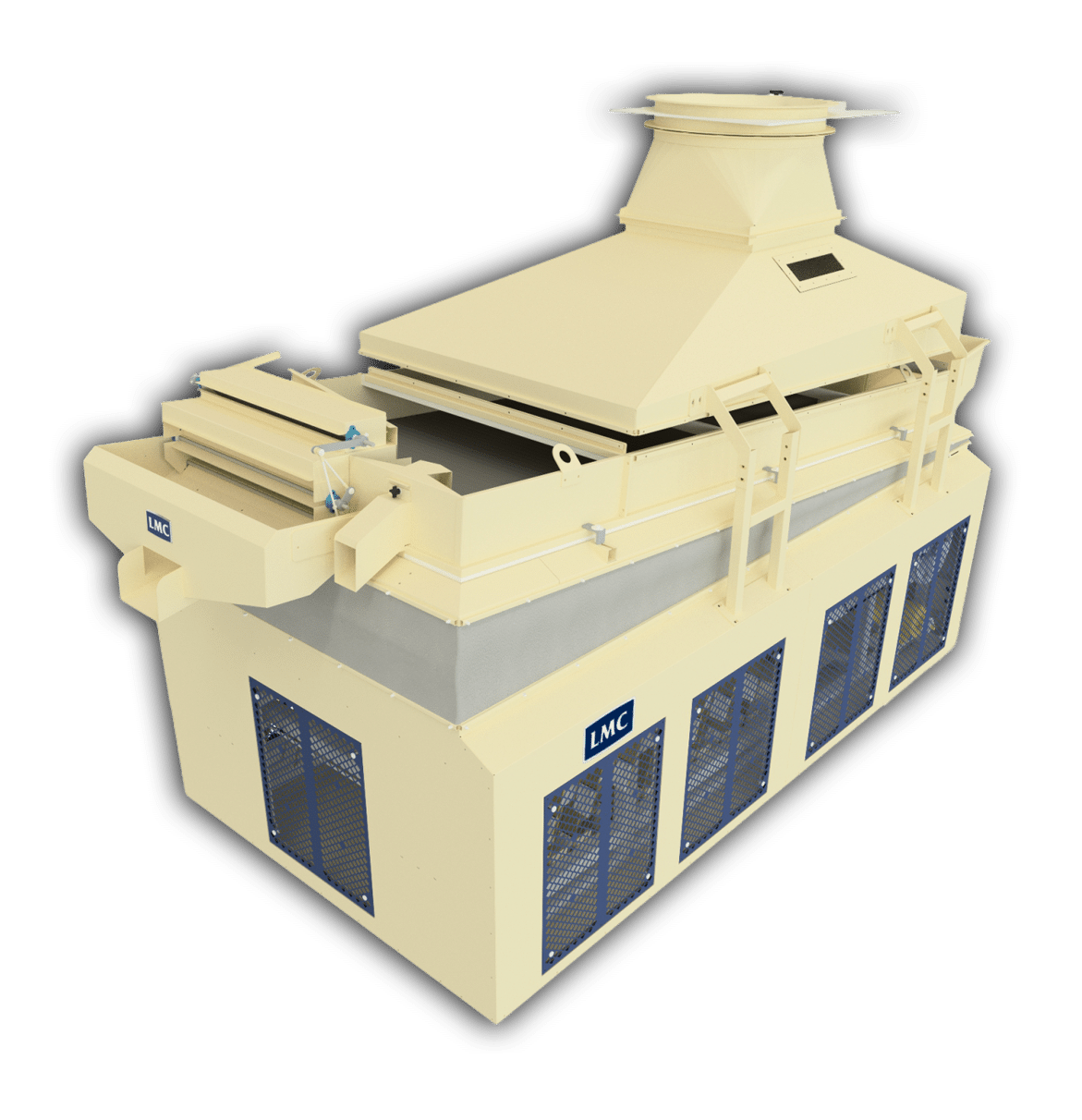
Density matters most for cereal-specific contamination. Ergot bodies and frost-damaged kernels are lighter than sound grain, and a gravity separator is built to separate on exactly that difference.
More than 100 LMC gravity separators are running across Western Canada, and the same design is at the core of most cereal lines Vistasort configures. See LMC gravity separators.
Each cereal shares the same core line but needs different configuration decisions. Here is the usual equipment path for each. Screen sizes and settings depend on variety and harvest year, so ask us for exact specs.
| Crop | Goal | Key challenges | Equipment path |
|---|---|---|---|
| Wheat | Milling or export grade | Wild oats, ergot, frost-damaged kernels | |
| Durum | Pasta-grade purity | Foreign material close in size to durum, ergot, discolored kernels | |
| Barley (malt and feed) | Clean grain, plus plumpness for malt | Maltsters grade on the percentage of plump kernels | |
| Oats | Scalp chaff, keep the long kernel | Needs slotted screens; dehulling for food grade | |
| Rye and Triticale | Ergot-free feed, milling and seed | Most prone to ergot of the cereals; light kernels | |
| Corn | Clean, sound kernels | Discolored and damaged kernels, foreign material |
Swipe to see all 6 crops →
Dark = the machine that makes the biggest difference for that crop.
General guidance only. Grade tolerances for wild oats, ergot and other contaminants follow the Canadian Grain Commission's Official Grain Grading Guide. Contact Vistasort for crop-specific recommendations before ordering.
Every machine in a line of cereal grain cleaning equipment has one job. Set up correctly, each stage lowers the load on the next one.
Field-run grain carries dust, chaff and light debris. An aspirator removes light material first, and a magnetic separator pulls metal before it reaches the rest of the line.
The main separation step. Screens sized to the crop scalp straw and oversize and remove broken kernels and small weed seeds. Most of the cleaning happens here.
An indent separator removes wild oats by length, a gravity separator removes ergot and frost damage by density, and a destoner removes stones. Malt barley runs through a sizing shaker here.
The VistaSort color sorter is the final check, rejecting discolored, damaged and leftover ergot kernels. Conveyance moves grain gently between every stage.
The VistaSort optical color sorter sorts wheat, durum, barley, oats and corn. Models run from the VistaSort Mini through 12-chute, with 200+ systems installed worldwide.
The contamination and grading problems that come up most often on cereal lines, and the cereal grain cleaning equipment that fixes each one.
Wild oats are close enough in width to wheat and barley that screens alone cannot reliably remove them. Length is the difference worth separating on.
Ergot bodies and frost-damaged kernels are usually less dense than sound grain, so density is the separation that works, with color as the final check.
Maltsters pay a premium for plump kernels that germinate and modify evenly, a spec primary screening cannot guarantee on its own.
Long oat kernels need slotted screens rather than round holes, and food-grade markets need the hull removed.
Swipe to see all 4 challenges →
Anyone can sell you an air screen cleaner. Configuring cereal grain cleaning equipment that actually makes your grade, on your crop and in your conditions, takes knowing how wild oat length, ergot density and malt plumpness interact with the machines available.
Steven Chivilo holds a Master's Certificate in Grain Operations Management from Kansas State University and is PMP certified. Chris Hammel has spent 40 years configuring seed and grain cleaning lines across Western Canada. Between them, they have built cereal lines around every contaminant on this page.
Ship us a sample of the wheat, durum, barley, oats, rye or corn you are cleaning. We will show you what properly configured cereal grain cleaning equipment removes, with no obligation to buy.
Local 306-242-9292 | info@vistasort.com