
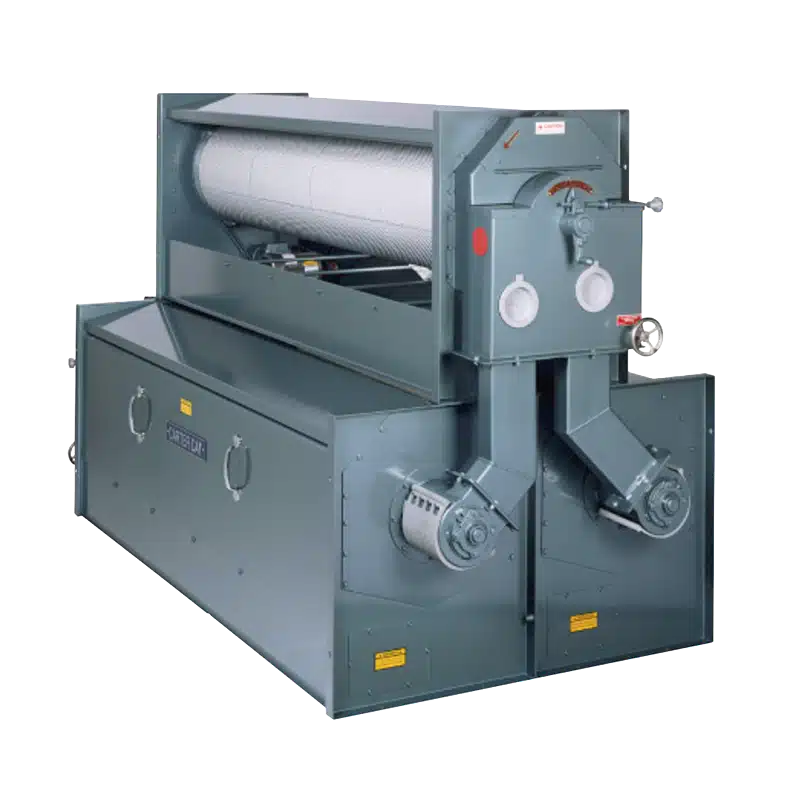
Make several length separations in a single machine. Carter Day disc separators pull weed seeds, oats, and broken kernels out of wheat, barley, rice, and grass seed, and the Disc Cylinder Separator delivers five clean streams in one pass. Supplied and installed across Western Canada by Vistasort, Saskatoon, Saskatchewan.
A disc separator grades seed and grain by length. Inside the machine, a series of cast discs turns on a horizontal shaft through the product. Each disc carries hundreds of undercut pockets that pick up shorter kernels and lift them out of the mass, while longer kernels are rejected and conveyed to the end of the machine.
What sets the disc separator apart is flexibility. Different pocket styles and sizes can be fitted along the same shaft, so one machine can remove weed seeds at the inlet end, split wheat from oats further down, and send each fraction to its own discharge. Carter Day calls it the standard of the world for multiple length separation.
Carter Day disc separators are built by Carter Day International and supplied in Western Canada by Vistasort. For single-pass precision grading, see our Carter Day indent separators.
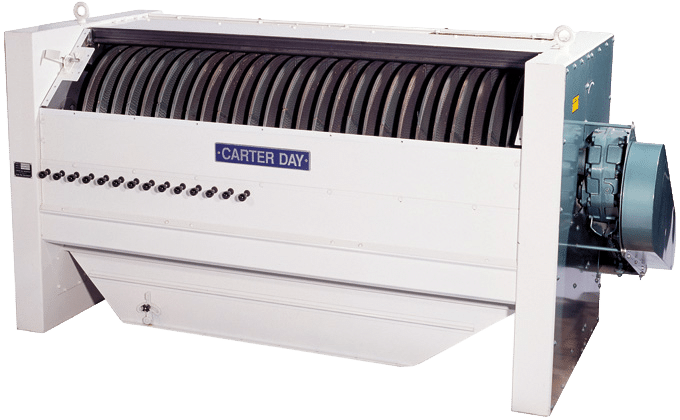
The pocket decides what gets lifted. Here is what happens as product travels from the inlet to the discharge of a Carter Day disc machine.
The inlet feeder spreads product evenly across the discs, giving a proportional burden depth and consistent contact with the lifting edge of each pocket.
Short kernels fit into the rotating disc pockets and are lifted out of the longer product. Just past top dead centre, they are thrown out of the pocket into the liftings trough, much like a bucket elevator cup discharging.
Longer product is always rejected by the pockets. Conveyor blades on the discs move it toward the end of the machine, with retarder panels between discs and a main product retarder at the outlet controlling burden depth.
Near the tail end, trap doors in the lifting trough can send liftings back to the inlet on a return conveyor for another pass. Each fraction then leaves through its own discharge. Products need at least a 1/16" difference in length for a good separation.
Every Carter Day disc is identified by a code. The letter is the pocket style, which sets the shape of seed it lifts. On small pockets, a number after the letter gives the pocket width in millimetres. Here is what the most common letters mean.
The V comes from vetch, a small round seed. The pocket has a round lifting edge and a square leading edge, designed to pick up small, round seeds or particles, such as weed seeds in wheat.
The R comes from rice cleaning, where this pocket was developed. It is similar to a V pocket but has straight lifting edges and a curved top edge, designed to lift small, irregular-shaped material.
These letters are Carter Day style codes for larger square or rectangular pockets, not abbreviations. They have no number after them. They lift shorter kernels quickly to raise capacity, or split the stream so each part can be sized separately.
V and R pockets are made only in small sizes, from 2.5 mm to 7 mm, so they always carry a number. A V5.5 disc is a vetch-style pocket 5.5 mm wide, and an R5 disc is a rice-style pocket 5 mm wide. Codes with no number, like A or MM, are the larger square-faced styles.
When liftings are 25% or less of the input, such as seeds out of wheat, pockets usually get progressively larger from the feed end to the discharge end. The smallest particles come out first, with larger liftings removed as product moves through.
Every control an operator needs to set burden depth, check the cut, and clean out between crops.
Spreads product evenly to give proportional burden depth and consistent lifting edge contact across the discs.
Control product flow from the inlet to the discharge, with a main product retarder at the outlet to hold the correct burden depth when capacities are low.
Capture lifted grain for reprocessing and send it back to the front of the machine on a conveyor.
Let the operator inspect how the length grading is performing.
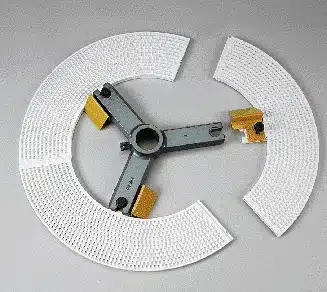
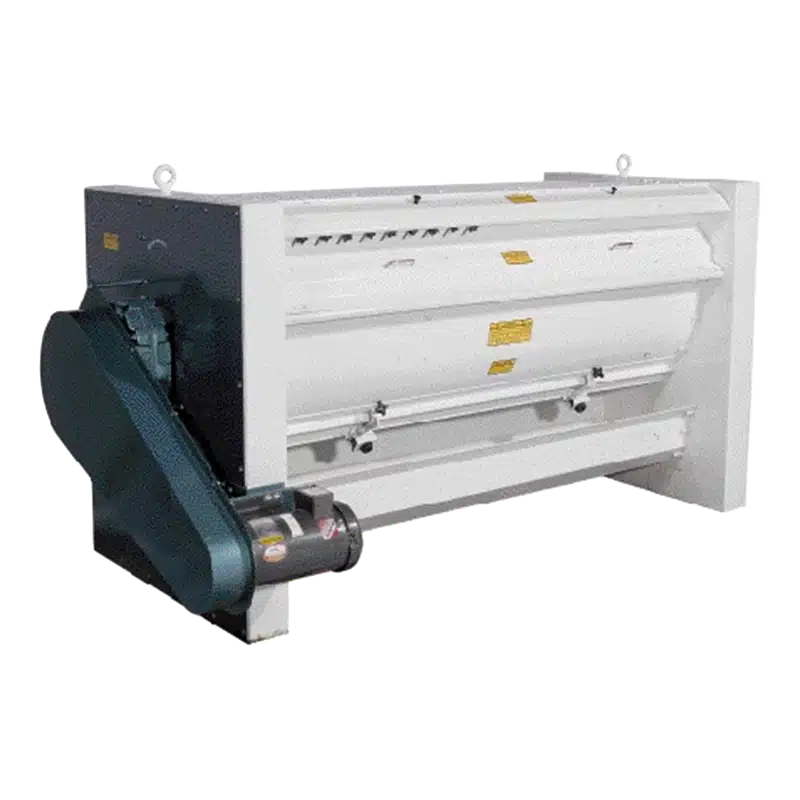
Carter Day's own application example. Wheat carrying 2 to 4% weed seeds, which are shorter than the wheat, and 2 to 4% oats, which are longer, is fed into the machine. The discs are arranged in two groups so one machine produces three separate streams.
V pockets sized to the weed seeds lift them out first and discharge them into a liftings trough at the right front of the machine.
MM pockets lift the wheat away from the oats and discharge it at the left front. Trap doors allow small wheat to be reprocessed if the discs lift too aggressively.
The oats are too long to be lifted, so the disc blades convey them to the outlet at the end of the machine.
The Disc Cylinder Separator combines the high capacity of a disc separator with the precision of Carter Day's indented Uniflow cylinders. A disc machine is paired with No. 3SI Uniflow cylinders, each 17" in diameter and 90" long, to separate and size product by length into five streams in one continuous process.
For more capacity, the Disc Cylinder Separator can be coupled with two additional No. 3SI Uniflows, run in series or parallel with the top unit.
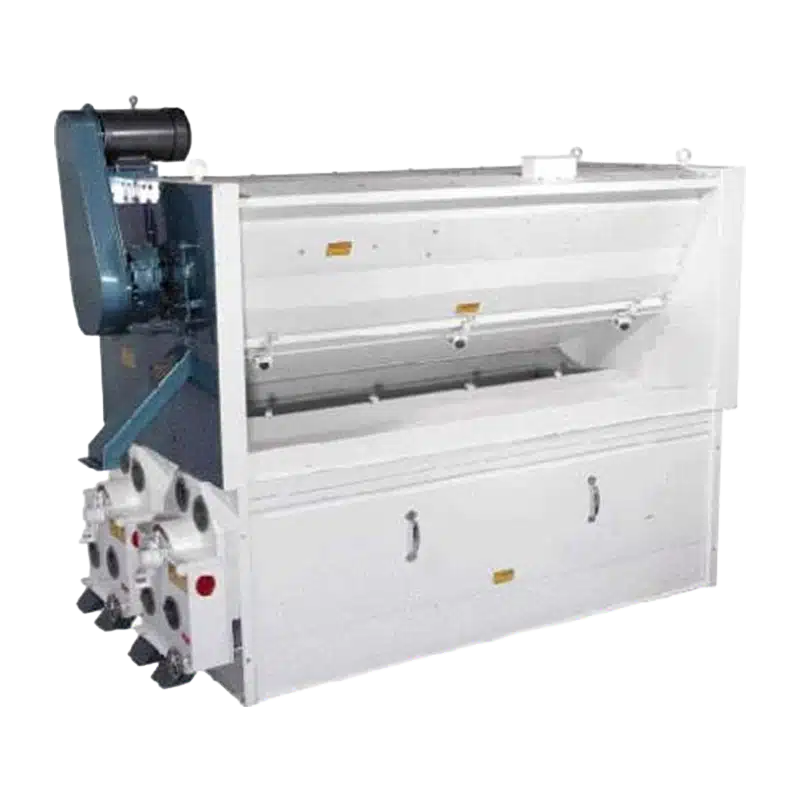
How product moves through the Disc Cylinder Separator, step by step, based on Carter Day's product stream description.
The disc portion of the machine is divided into two parts: a Splitter Section and a Grader Section.
Large square pockets lift 40 to 60% of the flow (medium grain, small grain, and weed seeds) and pass it to the Grader Section. The large grain and oats that are not lifted go to the Oat Cylinder.
V and R pockets lift the weed seeds and small grain and send them to the Seed Cylinder. The grain that is not lifted leaves as the Medium Clean stream.
An indent cylinder length grades the large grain away from the oats.
An indent cylinder length grades the weed seeds and broken kernels away from the small grain.
Typical capacities published by Carter Day. Actual capacity depends on the disc pocket arrangement, the crop, and how much of the product needs to be removed.
| Product | Short Removal | Long Removal | Short & Long Removal |
|---|---|---|---|
| Wheat (Small) | 275 / 7.4 | 350 / 9.5 | 100 / 2.8 |
| Wheat (Medium) | 210 / 5.7 | 300 / 8.2 | 85 / 2.3 |
| Wheat (Large) | 150 / 4.0 | 225 / 6.1 | 70 / 1.9 |
| Barley | 220 / 4.8 | 280 / 6.0 | 90 / 2.0 |
| Oats | 200 / 2.9 | 400 / 5.8 | Not listed |
| Sunflower (2520) | Not listed | 400 / 5.8 | Not listed |
| White Rice | 100 / 2.7 | Not listed | Not listed |
| Grass Seed | 2,200 lbs / 1.0 | 3,500 lbs / 1.5 | 900 lbs / 0.4 |
| Product | Model 2533 | Model 2533 HC |
|---|---|---|
| Wheat (Small) | 350 / 9.5 | 440 / 12.0 |
| Wheat (Medium) | 315 / 8.5 | 400 / 10.9 |
| Wheat (Large) | 245 / 6.7 | 245 / 6.7 |
| Barley | 280 / 6.0 | 350 / 7.6 |
| Oats | 200 / 2.9 | 250 / 3.6 |
| Paddy Rice | 250 / 5.0 | 300 / 6.1 |
| Grass Seed | 4,500 lbs / 2.0 | 5,000 lbs / 2.2 |
Source: Carter Day Disc Separator and Disc Cylinder Separator brochure (AG32-2023). Grass seed capacities are in pounds per hour. The HC (high capacity) configuration uses additional indent cylinders. Each figure is based on a specific disc and cylinder arrangement; contact Vistasort for the setup that suits your crop.
Need more than one length separation?
Request a Quote Call 1-800-667-6924Disc separators are widely used in grain cleaning, seed conditioning, and specialty crop processing wherever more than one length separation is needed.
V and R pockets sized to the weed seed lift small, round, or irregular seeds out of wheat and barley before the crop moves on to further cleaning.
Square-faced pockets lift wheat or barley away from longer oats, leaving the oats to discharge at the end of the machine.
R pockets were developed from the rice cleaning process. The disc separator handles white rice short removal, and the Disc Cylinder Separator is rated for paddy rice.
Carter Day publishes grass seed capacities for both the disc separator and the Disc Cylinder Separator, using fine V and R pockets for small seed.
Getting the disc arrangement right is what makes a disc separator perform. Vistasort has been installing Carter Day equipment for more than 40 years.
Vistasort is an authorized Carter Day dealer for Western Canada, serving seed and grain processors across Saskatchewan, Alberta, and Manitoba from Saskatoon.
Our team has installed Carter Day length grading equipment in seed plants and grain cleaning facilities across the Prairies for four decades.
We help you decide between a disc separator, a Disc Cylinder Separator, or Uniflow indent separators based on your commodity, contaminants, and capacity.
From pre-cleaning to color sorting and packaging, Vistasort's plant design and build team fits Carter Day equipment into a full processing line.
Answers to common questions about Carter Day disc separators and Disc Cylinder Separators.
Call or email Vistasort, your authorized Carter Day dealer for Western Canada. Tell us your crop, what you need to remove, and your target capacity, and we will recommend the right disc arrangement for your operation.